


 Cart
Cart
 sales@molnova.com



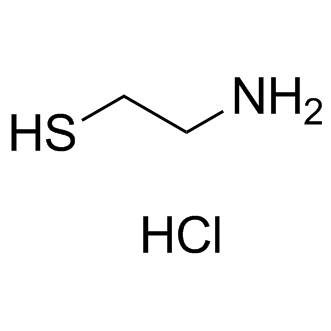
Cysteamine hydrochloride
CAS No. 156-57-0
Cysteamine hydrochloride( 2-Mercaptoethylamine hydrochloride )
Catalog No. M12233 CAS No. 156-57-0
An agent for the treatment of nephropathic cystinosis and an antioxidant; increases intracellular glutathione levels in cystinotic cells, also increases the rates of apoptosis in cystinotic cells.
Purity : >98% (HPLC)
 COA
Datasheet
HNMR
HPLC
MSDS
Handing Instructions
COA
Datasheet
HNMR
HPLC
MSDS
Handing Instructions
| Size | Price / USD | Stock | Quantity |
| 500MG | 38 | In Stock |


|
| 1G | Get Quote | In Stock |
|
Biological Information
-
Product NameCysteamine hydrochloride
-
NoteResearch use only, not for human use.
-
Brief DescriptionAn agent for the treatment of nephropathic cystinosis and an antioxidant; increases intracellular glutathione levels in cystinotic cells, also increases the rates of apoptosis in cystinotic cells.
-
DescriptionAn agent for the treatment of nephropathic cystinosis and an antioxidant; increases intracellular glutathione levels in cystinotic cells, also increases the rates of apoptosis in cystinotic cells; is an excellent scavenger of OH and HOCl and also reacts with H2O2; significantly increase the intracellular GSH levels; also causes autophagosome accumulation in cancer cells.Other Indication Approved(In Vitro):Cysteamine hydrochloride (2-Aminoethanethiol hydrochloride) has been shown to increase intracellular glutathione levels in cystinotic cells, thus restoring the altered redox state of the cells. Also increased rates of apoptosis in cystinotic cells, which are thought to be the result of increased caspase 3 and protein kinase Cε activity, is counteracted by Cysteamine hydrochloride administration. Cysteamine hydrochloride has antioxidant properties as a result of increasing glutathione production. Cysteamine hydrochloride is an excellent scavenger of OH and HOCl; it also reacts with H2O2. Cysteamine hydrochloride increases the production of several heat shock proteins (HSP), including the murine Hsp40. Cysteamine hydrochloride exerts a dose-dependent effect on the doxorubicin-induced death of cancer cells, measured in both HeLa cells and B16 cells, whereas Cysteamine hydrochloride treatment alone had no influence on cell survival. In addition, in a doxorubicin-resistant breast cancer cell line, the addition of Cysteamine hydrochloride to doxorubicin results in a dramatic increase in cell death.Cysteamine hydrochloride (100 μM) significantly is able to increase the intracellular GSH levels and the percentage of embryos that developed to the blastocyst stage of culture matured oocytes.
-
In Vitro——
-
In Vivo——
-
Synonyms2-Mercaptoethylamine hydrochloride
-
PathwayAutophagy
-
TargetAutophagy
-
RecptorOthers
-
Research AreaOther Indications
-
IndicationOther Disease
Chemical Information
-
CAS Number156-57-0
-
Formula Weight113.6096
-
Molecular FormulaC2H8ClNS
-
Purity>98% (HPLC)
-
Solubility10 mM in DMSO
-
SMILESC(CS)N.Cl
-
Chemical NameEthanethiol, 2-amino-, hydrochloride (1:1)
Shipping & Storage Information
-
Storage(-20℃)
-
ShippingWith Ice Pack
-
Stability≥ 2 years
Reference
1. Besouw, M, et al. Drug Discov Today, 2013. 18(15-16): p. 785-92.
2. de Matos, D.G, et al. Mol Reprod Dev, 1995. 42(4): p. 432-6.
3. Wan XM, et al. Int J Cancer. 2011 Sep 1;129(5):1087-95.
molnova catalog



related products
-
NL-1
NL-1 is a mitoNEET inhibitor with antileukemic effect.
-
Autogramin-2
Autogramin-2 potently inhibits?autophagy?induced by either starvation with IC50 of 0.27 μM, and inhibits mTORC1 (Rapamycin; IC50:0.14 μM)
-
Insecticidal agent 3...
Insecticidal agent 364 is a selective small molecule inhibitor of rapamycin kinase target protein.
